Factory Automation
High-speed production lines operate thousands of installed cameras monitoring assembly, quality, and safety zones. Every one of them generates a continuous video stream, and the overwhelming majority of those frames show a line running normally — information that has already been captured and transmitted many times over.
ERN-AI processes these feeds as event streams. A line running to specification produces almost no events. A deviation produces events immediately, at the sensor, without waiting for a frame to traverse the network to a GPU.
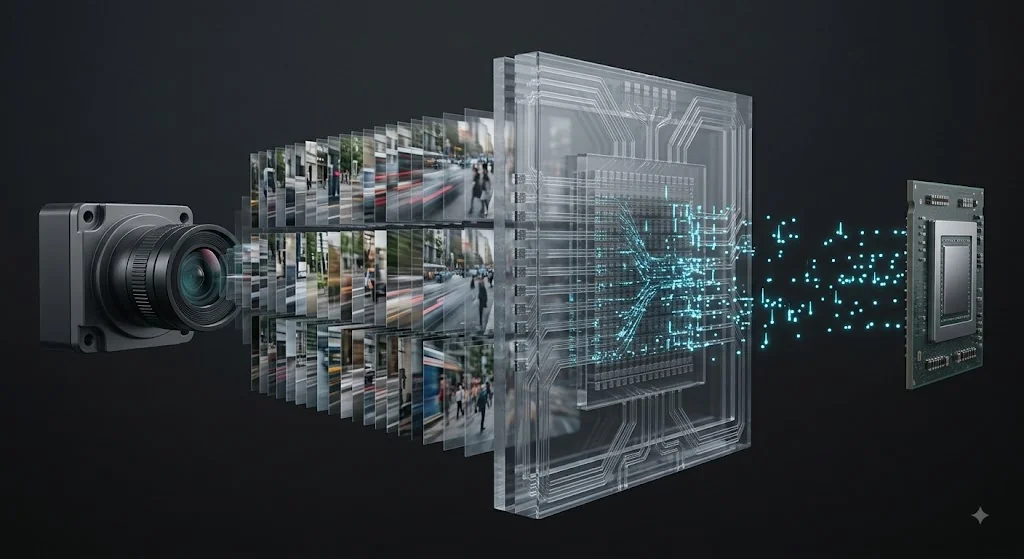
- ◆Network load drops in proportion to scene stability rather than camera count.
- ◆GPU inference capacity is spent on anomalies rather than on confirmation of normal operation.
- ◆Safety-zone monitoring gains latency headroom, because detection happens at the edge.
- ◆Existing cameras stay in place; there is no line-down migration window.
Machine Inspection
Visual defect detection and quality assurance workflows currently require expensive GPU inference infrastructure to process every frame at line speed. The economics are unforgiving: inspection throughput is bounded by inference throughput, and inference throughput is bought in GPUs.
ERN-AI changes the unit of work. Instead of running a model over every frame, the ALB array operates on extracted events, so inference cost tracks the rate of meaningful change rather than the frame rate of the camera.
- ◆Inspection stations can run at higher line speeds on the same hardware.
- ◆GPU capital expenditure and power draw fall for a given inspection volume.
- ◆Low-light inspection becomes viable without IR illumination, verified below 5 lux.
- ◆Additional stations can be added without a proportional inference budget increase.
Warehouse Robotics
Autonomous humanoid and mobile robots and pick-and-place systems need high-resolution perception at low latency — and they need it inside a battery budget. These three requirements pull against each other in any frame-based architecture: resolution increases data volume, data volume increases latency and power.
ERN-AI decouples them. Event-driven sensing means data volume scales with scene activity rather than with resolution, so a higher-resolution sensor does not automatically impose a higher compute and power cost.
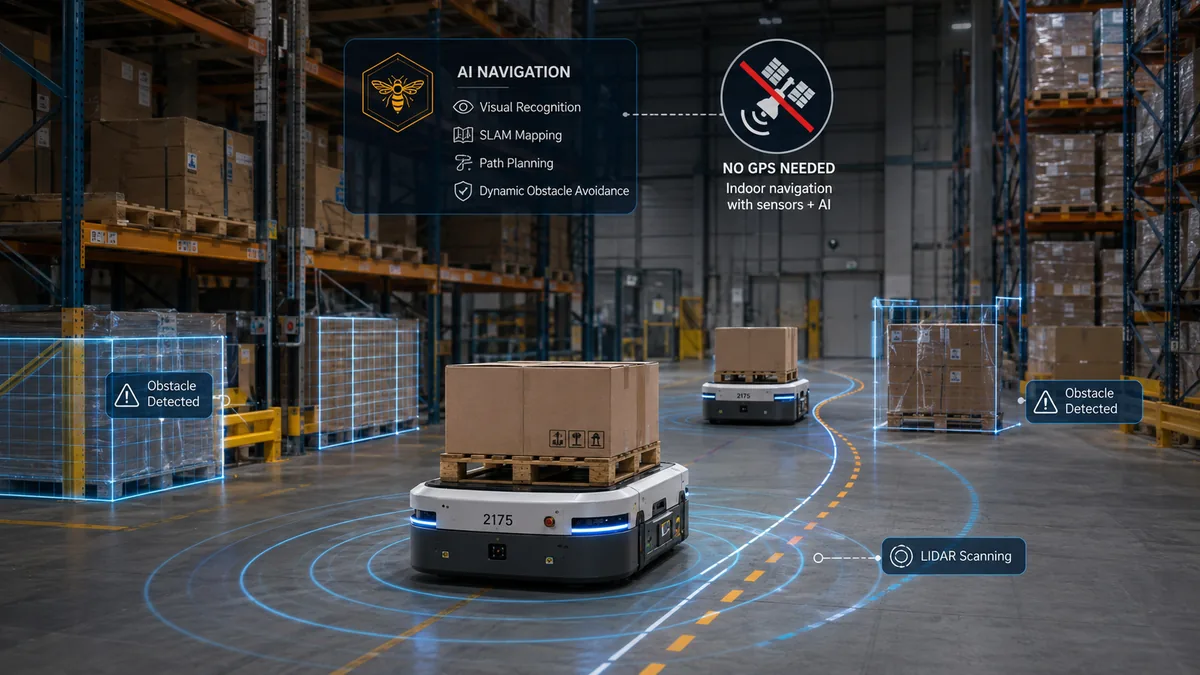
- ◆Higher-resolution perception without a proportional power penalty.
- ◆Lower reaction latency, because processing happens at the sensor.
- ◆Longer runtime per charge on the same battery.
- ◆Reliable operation in dim aisles and low-light storage areas without IR.
Smart Manufacturing
Industry 4.0 programs consistently stall at the same point: the existing camera infrastructure is not AI-ready, and replacing it means a capital project with a multi-year payback and significant production downtime.
ERN-AI is a software retrofit. It adds event-driven intelligence to legacy camera infrastructure without full system replacement, which turns an infrastructure project into a deployment.
- ◆No capital replacement cycle and no production downtime for sensor swaps.
- ◆Deployment measured in weeks rather than quarters.
- ◆Legacy cameras become viable AI data sources rather than depreciating liabilities.
- ◆Forward compatible: the same software layer runs on neuromorphic sensors when they are adopted.