The Problem: Sensing Data Is Broken
Autonomous physical-AI systems generate enormous volumes of perception sensing data — yet over 95% of it is redundant.
A frame-based camera running at 30 frames per second in a static warehouse aisle transmits thirty nearly identical images every second. The information content changes only when something moves. Everything else is duplicated pixels consuming bandwidth, inference cycles, and disk.
Three Compounding Failures
Redundant data
Frame-based cameras capture the entire scene at a fixed rate regardless of whether anything in that scene has changed. Redundancy is designed into the capture model itself.
Bandwidth overload
A mid-sized industrial site runs hundreds to thousands of simultaneous video feeds. Aggregate throughput scales linearly with camera count, and network capacity becomes the binding constraint long before analytical capability does.
AI compute and storage cost
Every redundant frame that reaches a GPU is paid for twice — once in inference cost and once in storage. This is the primary driver of poor ROI and slow response times in large-scale vision deployments.
An Architectural Flaw, Not a Bug
This cannot be solved by compression, better models, or more GPUs. Compression reduces the cost of moving redundant data but does not eliminate the redundancy. Larger models increase the cost per frame. Adding compute scales the expense linearly with the problem.
The redundancy originates at the point of capture, which is where it has to be removed.
See how ERN-AI removes redundancy at the sensor →ERN-AI: Perception-Native Software with AI-Lego-Blocks
ERN-AI (Evolutionary, Reconfigurable, Neuromorphic AI) is NuMorph AI's patent-pending core software. It is a perception-native compute layer that sits between the sensor and the downstream AI stack, converting continuous frame data into sparse event representations before that data ever reaches the network or the GPU.
What Is an AI-Lego-Block (ALB)?
An AI-Lego-Block, or ALB, is the atomic unit of ERN-AI. Each ALB is a micro-scale neuromorphic processing element developed from the neurology of honeybees, whose visual systems perform sophisticated motion detection, navigation, and classification on a brain of roughly one million neurons and a power budget measured in microwatts.
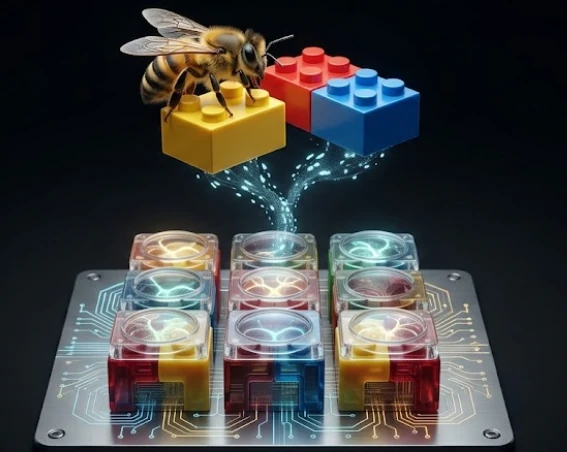
lower power than equivalent frame-based processing
trained on local micro-data, not on centralized datasets
executing at the sensor rather than in the cloud
How ALBs Compose into ERN-AI Software
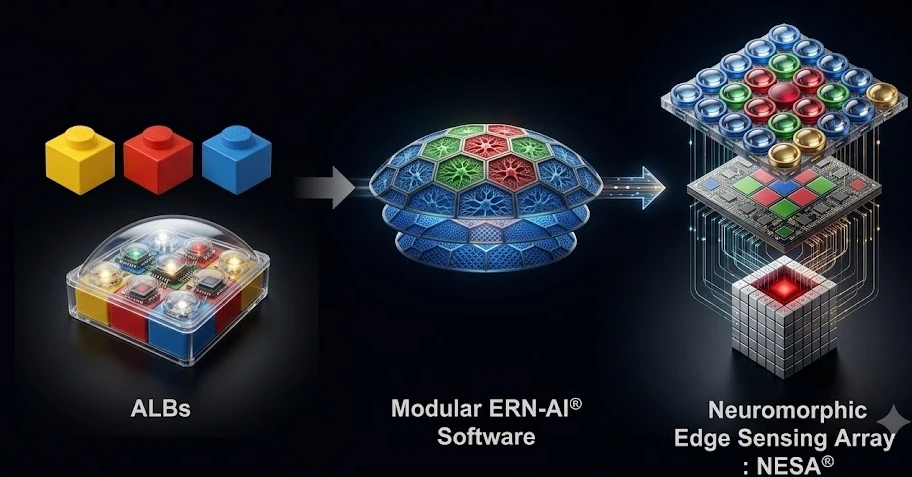
ERN-AI software is assembled from arrays of ALBs, configured to the requirements of the deployment. The composition is modular, scalable, distributed, and decentralized — there is no central inference bottleneck, and array size can be matched to the complexity of the scene rather than fixed at design time.
What Is NESA?
NESA (Neuromorphic Edge Sensing Array) is NuMorph's vision sensing array architecture. It organizes ALB arrays into a layered sensing structure that is evolutionary and reconfigurable in real time — the array can restructure its own processing topology as scene conditions change, without redeployment or retraining.
Intellectual Property Status
ERN-AI is patent pending. Proof-of-concept demonstrations have been completed and are available for review under NDA.
How ERN-AI Works
ERN-AI does not replace the imaging pipeline. It inserts two stages into it.
Current tech: CMOS digital capture
The existing camera captures frames exactly as it does today. No hardware change, no firmware replacement, no recalibration.
Digital-analog event extraction
Incoming frames are converted from a dense frame representation into a sparse event representation. Only changes in the scene generate events; static regions generate nothing.
ERN-AI software with AI-Lego-Blocks
The ALB array processes the event stream directly. Motion detection, classification, and scene interpretation happen here, at the edge, on the event data rather than on full frames.
Reduced compute load
Downstream inference operates on a fraction of the original data volume. In tested 10×10 ALB array configurations, NuMorph measured approximately 500× compute load reduction.
Reduced bandwidth
Only events and derived results travel across the network. Raw video no longer needs to be transmitted or stored by default.
No Change to Your Hardware Stack
There is no requirement for any other change in the current digital CMOS hardware stack. ERN-AI is compatible with the cameras already installed and remains compatible with future neuromorphic sensing hardware as it becomes available.
See the measured proof-of-concept results →ERN-AI Proof-of-Concept Results
NuMorph has completed proof-of-concept demonstrations of ERN-AI software. The following results are measured, not modeled.
Verified Capabilities
Works with current & future sensing tech
ERN-AI operates on conventional digital CMOS camera output today and is architecturally compatible with neuromorphic sensors as they reach the market.
Motion detection in low light
Event-driven motion detection and classification in daylight and below 5 lux, without infrared illumination or IR sensors — removing both the hardware cost and the deployment visibility of IR arrays.
Validated across five configurations
Testing covered 1×1, 3×3, 5×5, 7×7, and 10×10 ALB-array configurations.
~500× compute load reduction
At the 10×10 ALB array configuration, ERN-AI demonstrated approximately 500× reduction in compute load relative to frame-based processing of the same input.
Test Summary
A demonstration video showing ERN-AI AI-Lego-Block arrays in operation, from 3×3 up to 10×10 configurations, is available.
Video transcript
Welcome to NuMorph AI. Current big AI models are not suitable for edge or extreme edge. NuMorph AI introduces massively modular evolutionary reconfigurable neuromorphic ERN-AI software from the neurology of honeybee's vision system. Highly efficient individual small data trained analog AI modules or AI Lego blocks are developed. ERN-AI software is a real-time configuration of many such AI Lego blocks for a given application. Like the building blocks or bricks of a building, ERN-AI Lego blocks are build them once, use them again and again for different applications. For example, event driven and selective cameras. Event-driven safety and security monitoring, day and night, rain or shine. ERN-AI software for motion detection and classification day or night with no IR sensors. For example, ERN-AI software for event driven sensing, alarm and recording, day or night, rain or shine. ERN-AI software for 3x3 AI Lego block array or neuromorphic edge sensing arrays analysis of a higher resolution video analysis for motion detection classification changing the resolution and focusing of a video analysis using AI Lego blocks array configurations. The various arrays show the capabilities of neuromorphic AI analysis of HD resolutions without increasing the workload. Here is the compute load saving in the training and inference of a 10x10 AI Lego blocks array configuration. The overall compute load or energy saving in both cases is around 500 times better using our current level code and compute infrastructure. ERN-AI software is compatible with current digital camera technologies. ERN-AI software is ready for next-gen neuromorphic camera technologies. NuMorph AI. Bee the Future. We are here.